
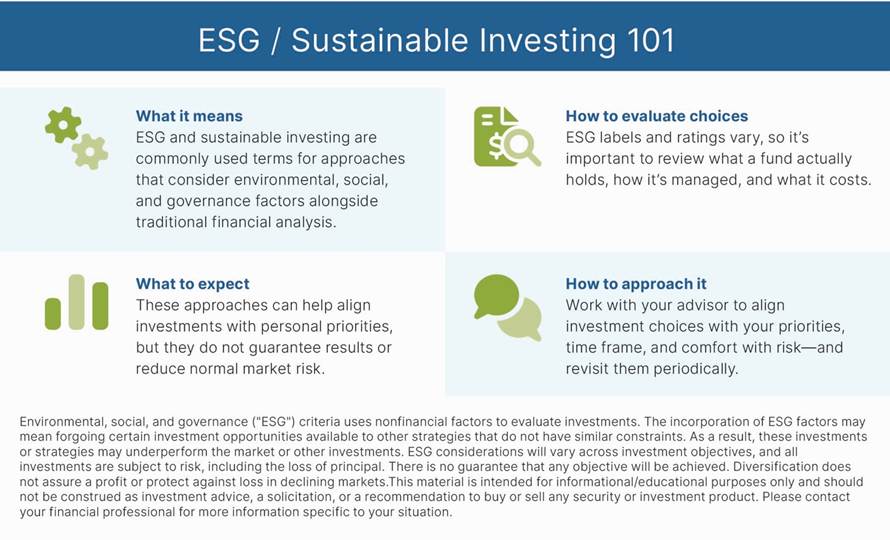
More investors are not only asking how their money grows, but also what it supports. That’s where environmental, social, and governance (ESG) investing comes in—also called sustainable investing. Put simply, it’s an approach that considers a company’s impact on the environment, people, and leadership practices alongside its financials. It can allow you to align your portfolio with your values while staying diversified and thoughtful about risk.
You can explore sustainable options that fit your objectives at any stage, whether you’re building a retirement plan, managing family savings, or just starting out.
What ESG Investing Really Means
ESG consists of three sets of factors:
- Environmental: energy use, emissions, waste, resource efficiency, and how a company plans for climate risks
- Social: employee treatment and safety, community impact, product safety, and customer privacy
- Governance: board independence, executive pay practices, shareholder rights, and overall transparency
Not every fund or company weighs these items the same way. Some tilt heavily toward clean energy; others focus on worker safety or board accountability. Others may consider ESG factors, to better evaluate and price in the risk and value of an issuer. The key is deciding which approach matter most to you and choosing options that reflect those priorities.
ESG vs. Traditional Investments
Traditional investing focuses mainly on business fundamentals such as revenue, profits, debt, and competitive position. ESG investing adds another lens. How are those results achieved, and does the company manage relevant risks responsibly?
Importantly, ESG investing is not a replacement for core investing principles. It’s an extra filter you can apply within a diversified plan. For example, a traditional energy fund might include a wide range of producers based on profitability. An ESG-oriented fund may lean toward firms that invest in renewables or improve efficiency and emissions reporting. Both approaches aim to participate in market returns; they just emphasize different inputs when choosing holdings. Performance will vary across funds and time, and no approach avoids normal market ups and downs.
Common Myths About ESG Investing
Myth 1: “It’s only about the environment.”
ESG goes beyond carbon footprints. It includes workplace safety, supply-chain practices, data security, and board oversight—factors many investors view as part of long-term risk management.
Myth 2: “You have to give up returns to invest responsibly.”
There’s no single outcome. Results differ by fund, fees, and market conditions. Some ESG strategies have kept pace with comparable non-ESG options at times; in other periods, they have looked different. The most practical approach is to evaluate any fund on its process, costs, and fit with your goals—not on a label alone.
Myth 3: “It’s a fad.”
ESG investing terms may evolve, but interest in transparency, data, and risk awareness has expanded across many parts of the market. The tools and definitions will keep changing, but the idea of aligning money with personal priorities or consideration of external risk factors will likely remain part of the conversation.
How to Explore Options with Your Advisor
If you’re interested in incorporating ESG or your values into your portfolio, a short conversation can go a long way. Together, you and your advisor can:
- Clarify your priorities. Name the issues that matter most—environmental impact, workforce practices, leadership accountability, or others—and rank them.
- Pick the right “route.” Options include broad-market funds with ESG screens, focused thematic funds (e.g., clean energy or water), and customized portfolios. Each has trade-offs in diversification, cost, and tracking error (how much it might differ from the market).
- Evaluate the data. ESG ratings and fund labels can vary by provider. Your advisor can help you look past marketing terms, review what’s actually held, and assess fees and methodology in plain language.
- Set expectations. Sustainable portfolios still experience market volatility. Build an allocation that matches your timeline and risk tolerance, then review it periodically.
- Check progress. Over time, you might adjust the mix as your priorities or the available options change.
A Balanced Perspective
ESG investing can be discussed in political terms, but for most individuals, it’s a personal choice about how to invest. You’re not required to adopt a specific stance, and you don’t need to overhaul everything at once. Some investors start with a single ESG fund; others prefer a gradual shift or a blend of approaches. What matters is choosing a path that aligns with your values and your financial plan.
Final Thought
ESG investing is about intention. If you want your portfolio to reflect what matters to you, there are practical ways to do that without losing sight of diversification and cost. If you’re curious, talk through your priorities with your advisor and map out options that fit.
Environmental, social, and governance (“ESG”) criteria uses nonfinancial factors to evaluate investments. The Incorporation of ESG factors may mean forgoing certain investment opportunities available to other strategies that do not have similar constraints. As a result, these investments or strategies may underperform the market or other investments. ESG considerations will vary across investment objectives, and all investments are subject to risk, including the loss of principal. There is no guarantee that any objective will be achieved. Diversification does not assure a profit or protect against loss in declining markets.
This material is intended for informational/educational purposes only and should not be construed as investment advice, a solicitation, or a recommendation to buy or sell any security or investment product. Please contact your financial professional for more information specific to your situation.
© 2025 Commonwealth Financial Network®
###
Summit Wealth Management is located at 3010 Harborview Drive, Suite 301, Gig Harbor, WA 98335 and can be reached at 253-858-2884.
Securities and advisory services offered through Commonwealth Financial Network. Member FINRA/SIPC. A Registered Investment Adviser. Fixed Insurance products and services offered through Summit Wealth Management.