
If January is about intention, then June is about information. By midyear, you can see what’s actually happened, like where your money went, how markets moved, and whether your financial plan still fits your life today. A June check-in can be helpful because you still have six months left to influence how the year ends.
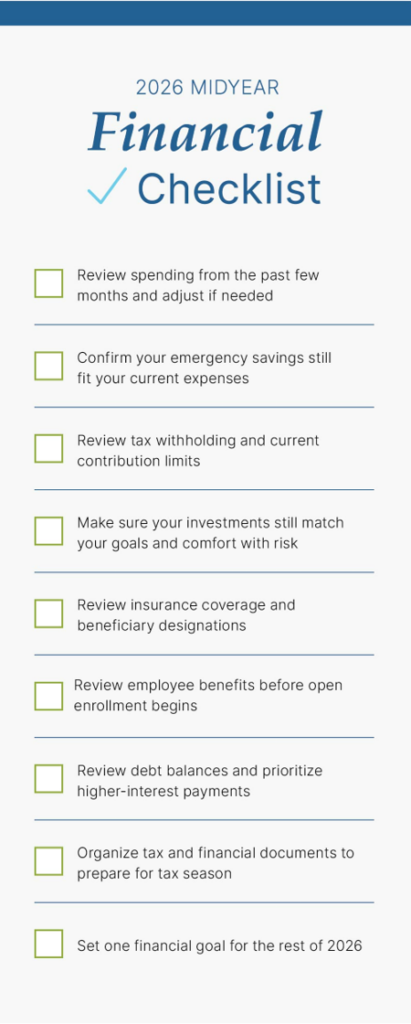
1. Reexamine Where Your Money Went
Start by looking at the last few months of your actual spending. Often, where your money really went will differ from what you planned in January. Insurance premiums may have risen. Summer activities add up. Subscriptions quietly renew. Even a modest $150–$300 monthly drift can translate into $900–$1,800 by year-end if left unchecked. Midyear is a good time to redirect small amounts toward something more intentional, such as boosting savings, paying down debt faster, or preparing for a known expense later this year.
Why this matters: Six months is enough time for small adjustments to make a noticeable difference by year-end.
2. Confirm Your Emergency Cushion Still Fits Your Life
Expenses change over time. If you have a new mortgage, childcare arrangements, travel, or new health care costs since January, your emergency fund may need to be adjusted. Strengthening this cushion while things are stable can help you avoid relying on credit cards or loans if something unexpected happens. Even modest, automatic transfers between now and December can make a meaningful difference.
Why this matters: Having accessible savings can help protect your long-term investments and reduce financial stress during unexpected events.
3. Make Sure Your Tax Strategy Reflects 2026 Rules
Taxes are easier to manage when you adjust gradually rather than waiting until the end of the year. If your income changed this year due to a raise, bonus, job transition, or side business, it may be worth reviewing your tax withholding. A midyear adjustment can help avoid an unexpected tax bill next April or prevent too much from being withheld from your paycheck for the rest of the year. Several inflation adjustments for 2026 are worth noting:
- The 401(k), 403(b), and similar workplace plan contribution limit increased to $24,500.
- Individuals age 50+ can contribute an additional $8,000 catch-up, and those ages 60–63 may qualify for a higher catch-up of $11,250.
- The IRA contribution limit increased to $7,500, with a $1,100 catch-up contribution for those age 50+.
- Health Savings Account (HSA) limits increased to $4,400 (individual) and $8,750 (family).
If you intend to maximize these limits, adjusting contributions now spreads the impact across the remaining pay periods rather than compressing changes into the final months of the year.
Why this matters: Small adjustments now can help you manage taxes more efficiently and prevent last-minute financial decisions.
4. Make Sure Your Investments Are Still Balanced the Way You Intended
Over time, markets move at different speeds. If stocks have performed strongly, for example, they may now represent a larger share of your portfolio than they did when you originally set your investment plan.
A midyear check-in is a good time to review your accounts and see whether that balance has shifted. In some cases, adjusting the investment mix can bring things back in line with the strategy you originally chose.
Why this matters: If one type of investment grows to dominate your portfolio, you may end up taking on more risk than you intended.
5. Review Insurance and Beneficiaries
When life changes, your coverage may need to change as well. At this midyear point, confirm that life, disability, home, and auto coverage reflect your current circumstances. Changes in income, new dependents, or new assets may warrant updates. Also, review beneficiary designations on retirement accounts and life insurance policies. These designations generally override instructions in a will, so keeping them current is important.
Why this matters: Accurate coverage and updated beneficiaries can help prevent complications later.
6. Evaluate Employee Benefits Before Open Enrollment
Midyear is a good time to think ahead to your next benefits enrollment period. If you are contributing to a Flexible Spending Account (FSA) or HSA, confirm that you are likely to use the money you’ve set aside. For 2026, the FSA salary reduction limit increased to $3,400, and some plans allow limited carryover, although unused funds may still be forfeited depending on plan rules. Planning now can help you make more confident benefit elections later.
Why this matters: Thoughtful benefits planning can help prevent forfeited dollars and reduce out-of-pocket costs.
7. Approach Debt with a Strategy
List your balances and interest rates. If you have extra money available, consider applying it first to the debt with the highest interest rate. Even modest additional payments can reduce total interest paid over time. You are also entitled to free annual credit reports from each of the three major credit bureaus through AnnualCreditReport.com. Reviewing them midyear gives you time to correct any errors before future financing needs arise.
Why this matters: Strategic repayment can improve financial flexibility and reduce borrowing costs.
8. Start Organizing Year-end Records Now
Create a simple 2026 file—digital or physical—for tax-related documents. Include charitable contributions, medical expenses, tuition payments, investment statements, and records of any side income or freelance work. Organizing records gradually throughout the year can reduce stress during tax season and decrease the likelihood of missing deductions or credits.
Why this matters: Better organization can improve accuracy and help ensure you don’t overlook potential tax savings.
9. Set One Focused Goal for the Second Half of the Year
Rather than trying to improve everything at once, choose one meaningful objective for the rest of 2026. You might increase retirement contributions by 1 percent, pay off one specific debt, or build an additional month of emergency savings. Focused goals tend to generate momentum—and momentum builds confidence.
Why this matters: Small, consistent actions often produce meaningful results over time.
The Advantage of Acting Now
By December, many financial decisions become urgent. In June, you still have flexibility. A thoughtful midyear check-in can help ensure you reach year-end feeling prepared rather than reactive. Six months is long enough to revisit tax planning, strengthen savings, and reinforce your financial stability, and a few thoughtful adjustments now can make a meaningful difference by year-end.
This material has been provided for general informational purposes only and does not constitute either tax or legal advice. Although we go to great lengths to make sure our information is accurate and useful, we recommend you consult a tax preparer, professional tax advisor, or lawyer.
Third-party links are provided to you as a courtesy and are for informational purposes only. We make no representation as to the completeness or accuracy of information provided at these websites.
© 2025 Commonwealth Financial Network®
###
Summit Wealth Management is located at 3010 Harborview Drive, Suite 301, Gig Harbor, WA 98335 and can be reached at 253-858-2884.
Securities and advisory services offered through Commonwealth Financial Network. Member FINRA/SIPC. A Registered Investment Adviser. Fixed Insurance products and services offered through Summit Wealth Management.